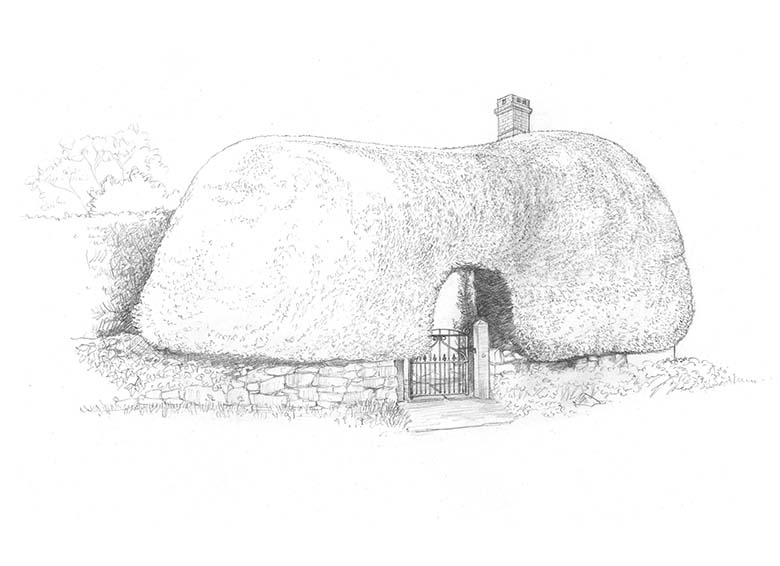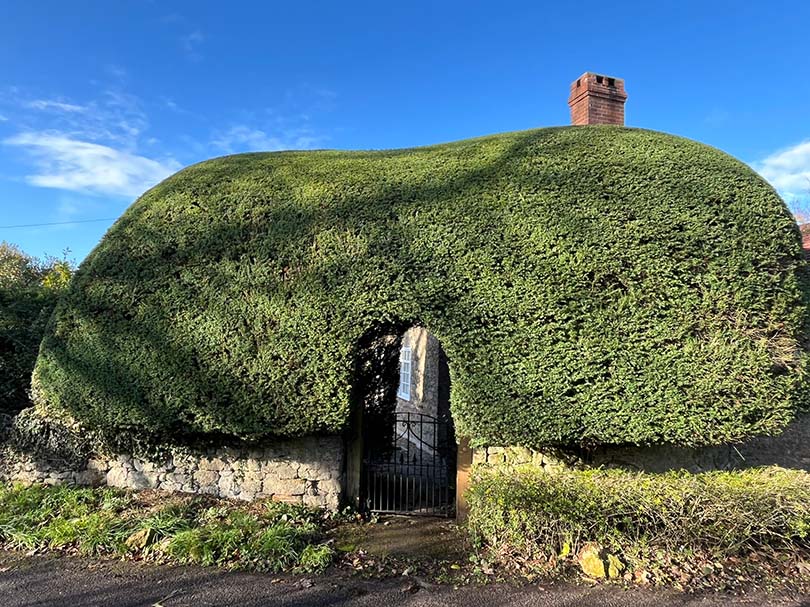
To reach the retreat room at Pen Selwood, guests pass through an archway formed by ancient yew topiary. This threshold, marked by one of Britain’s most sacred trees, is no accident. The yew has stood as guardian of transformation for millennia, and walking beneath its evergreen canopy is the first step into a space held for deep change.
Many guests find themselves naturally pausing beneath the yew archway, sensing something shifts as they stand within its embrace. There is a palpable energy here, a quietness that invites you to take a breath, to acknowledge the crossing from one space into another. The yew has held this threshold for decades, perhaps longer, and it knows about transitions. Stand a while. Let the ancient branches witness your arrival.
The Yew in Celtic Tradition
The yew’s association with transformation runs through the Celtic tradition like a deep root. In the Ogham — the ancient druidic alphabet where each letter represents a sacred tree — the yew is Ioho, the final letter. It signifies the completion of one cycle and the beginning of another: rebirth, regeneration, the ending of one phase and the emergence of the next. A spiritual initiation. The yew does not speak of gentle transition but of profound metamorphosis, the kind that happens when we truly let go of what no longer serves us.
Male and Female: The Yew’s Dual Nature
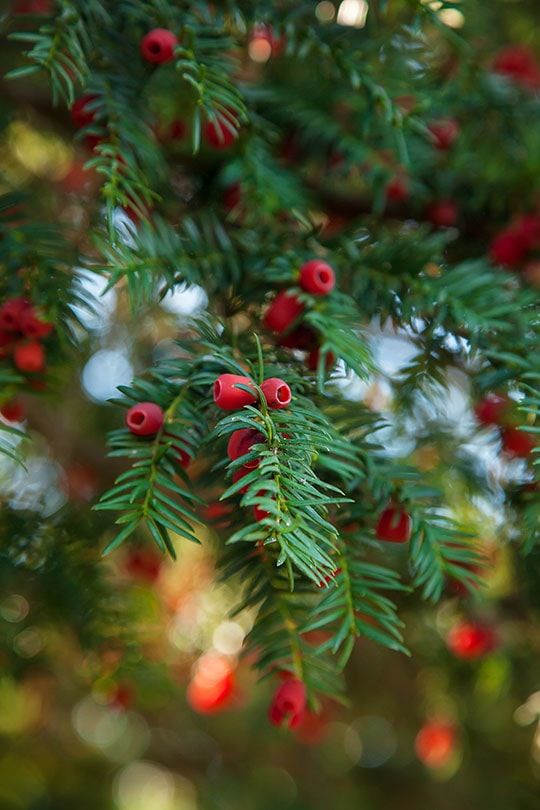
What makes the yew such a powerful symbol is written in its very nature. These are dioecious trees — meaning each is either male or female yet working in partnership across the forest. In spring, male trees release clouds of golden pollen on the wind to reach the smaller flowers of their female counterparts, who will bear the distinctive red berries come autumn. Occasionally, remarkably, ancient yews have been known to change sex, adding another layer to their shape-shifting wisdom.
Regeneration from Within: How Yews Renew Themselves
The tree’s longevity is legendary — some British yews are estimated at over 2,000 years old, with claims reaching back 5,000 years for the ancient Fortingall Yew in Perthshire. Yet their true gift is not just endurance but renewal. As yews age, their heartwood hollows, appearing to die from the centre outward. But this apparent decay conceals extraordinary vitality: aerial roots drop down from the canopy into the hollow trunk, rooting in the rich compost of fallen foliage, literally growing a new tree within the old. Death becomes the vessel for new life. The ending contains the beginning.
Poison and Medicine: The Yew’s Paradox
This paradox extends to the yew’s chemistry. Almost every part of the tree — bark, leaves, seeds — contains potent toxins capable of killing livestock and humans. The sweet red aril that surrounds the seed is the sole exception, edible and inviting, yet the seed within remains deadly. Ancient peoples knew this dual nature well: the Celts associated yew with Hecate, goddess of death and transformation; druids used yew staves for divination and ritual; and medieval Europeans believed the tree absorbed the vapours of the dead. Yet from this same poisonous bark comes paclitaxel, a powerful chemotherapy drug that fights breast, lung, and ovarian cancers by disrupting the growth of destructive cells. The yew holds both poison and medicine, death and healing, in perfect balance.
Why Yew Trees Stand in Churchyards
The question of why yews stand in nearly every old British churchyard has puzzled scholars for centuries. Multiple theories exist: that they were planted to deter cattle from grazing on consecrated ground (though many churchyards already had walls for this purpose); that they provided wind protection for the church; or that they secured wood for the famous English longbow (though records show most bow staves were actually imported from Italy and Spain, and ancient churchyard yews show no signs of having been harvested).
Sacred Sites: Churches Built Around Ancient Yews
The most compelling explanation reverses the question: perhaps we should not ask why yews were planted in churchyards, but rather why churches were built around yews. Many of Britain’s churchyard yews pre-date Christianity by centuries, even millennia. When Christian missionaries arrived, following the guidance of Pope Gregory in 601 to convert existing places of worship rather than destroy them, they built their churches on sacred sites already marked by ancient yews. The trees were there first, marking places of power and transformation long before stone churches rose around them.
The Yew as Threshold at Pen Selwood Retreats
For guests arriving at Pen Selwood Retreats, walking through the yew archway echoes this ancient practice of entering sacred space. Like those who came before — seeking healing, wisdom, or communion with deeper mysteries — retreat guests cross a threshold into transformation. The yew stands witness, as it has for millennia, to the human journey of releasing what has been and opening to what wants to emerge.
Whether your retreat brings gentle restoration or profound metamorphosis, the yew’s wisdom remains constant: true renewal requires us to become hollow at the centre, to let the old heartwood fall away, to trust that new growth can take root in what appears to be empty space. This is the yew’s gift — not just survival, but transformation as a way of being. Not despite the endings, but because of them.
We invite you to step through the yew archway at Pen Selwood Retreats.